From the SAP to the programs
In this chapter
- Say what the SAP decides and what the specifications decide.
- Make all products of the plan with
sapling build, in three parts. - Read the population flags in the ADaM specification.
- Time
- 20 minutes
- At the end you have
- the SAP as a PDF, the ADaM and TLF specifications, 12 shells, 7 ADaM programs and 12 table programs; nothing has run yet.
11.1 The idea: the SAP says what, the specifications say how
Section titled “11.1 The idea: the SAP says what, the specifications say how”The SAP says what is analysed: in which population, which variable, with which method. The specifications say how the data are made: how each ADaM variable is derived from SDTM, how each table is laid out. The programs are made from both. Nobody edits a program by hand: a change goes into the SAP or into a specification, and the program is made again.
The work has three parts, each with its owner:
| Part | Products | Owner |
|---|---|---|
| 1 The SAP | the structured SAP, its JSON, its PDF | the statistician |
| 2 The specifications | the ADaM specification (adam-spec.qmd), the TLF specification with the analysis contract, the shells, the QC specification |
the statistician and the programmer |
| 3 The programs | the ADaM programs, the table programs | the programmer |
11.2 Build
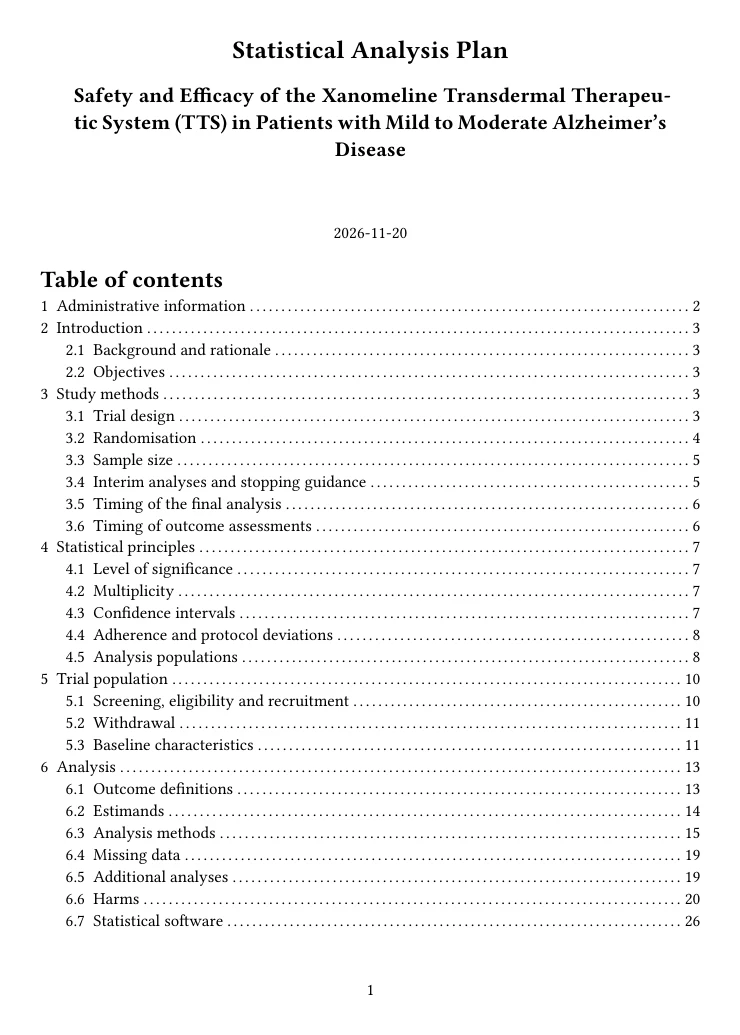
Section titled “11.2 Build”$ sapling build1 The SAP (the statistician)sap.qmd: 1 study, 27 grouping, 22 decision, 1 design, 1 sample_size, 4 population, 12 output, 33 analysis, 15 method, 1 estimand, 19 subset, 1 missing_data, 3 waiver, 1 multiplicity, 1 sensitivity, 1 software, 90 adam, 1 change; 0 error(s), 1 warning(s).sap structured PASS: out/sap/sap.md, sap.html (234 blocks) (0.1 s)sap json PASS: out/sap/sap.json (0.0 s)sap pdf PASS: out/sap/sap.pdf (Quarto, Typst; the extension _extensions/sapling) (3.7 s)2 The specifications (the statistician and the programmer) adam-spec.qmd: made from the SAP (yours to edit)adam spec PASS: adam-spec.qmd, out/adam/spec (7 data sets, define.md) (0.1 s) tlf-spec.qmd: made from the SAP (yours to edit) the chain's checker (sap_build.py): SAP BUILD PASS...tlf spec PASS: tlf-spec.qmd, out/tlf/spec (the contract; ARS JSON Schema: PASS (0 error(s))) (1.7 s)tlf shells PASS: out/tlf/shells: 12 shell(s) from the structured SAP (T14_1_1, T14_1_2, T14_2_1, T14_3_1, T14_3_2, T14_4_1, T14_5_1, T14_5_2, T14_5_3, T14_6_1, T14_6_2, T14_7_1) (0.0 s)tlf qc-spec PASS: out/tlf/qc-spec: 12 QC specification(s) from the structured SAP (0.0 s)3 The programs (the programmer)adam programs PASS: out/adam/programs (7 programs: ADSL -> ADAE -> ADQSADAS -> ADQSCIBI -> ADVS -> ADLBC -> ADLBH) (0.0 s)tlf programs PASS: out/tlf/programs (12 programs, RESULT: CLEAN) (0.2 s)6 sSAPLING BUILD PASSThe whole output (23 lines)
$ sapling build1 The SAP (the statistician)sap.qmd: 1 study, 27 grouping, 22 decision, 1 design, 1 sample_size, 4 population, 12 output, 33 analysis, 15 method, 1 estimand, 19 subset, 1 missing_data, 3 waiver, 1 multiplicity, 1 sensitivity, 1 software, 90 adam, 1 change; 0 error(s), 1 warning(s).sap structured PASS: out/sap/sap.md, sap.html (234 blocks) (0.1 s)sap json PASS: out/sap/sap.json (0.0 s)sap pdf PASS: out/sap/sap.pdf (Quarto, Typst; the extension _extensions/sapling) (3.7 s)2 The specifications (the statistician and the programmer) adam-spec.qmd: made from the SAP (yours to edit)adam spec PASS: adam-spec.qmd, out/adam/spec (7 data sets, define.md) (0.1 s) tlf-spec.qmd: made from the SAP (yours to edit) the chain's checker (sap_build.py): SAP BUILD PASS note: method ANCOVA_4_2 is named in the prose and used by no analysis: nothing is made of it (the ANCOVA has no model yet (dose, covariates, factors): the statistician completes it) note: method ANCOVA_4_3_3 is named in the prose and used by no analysis: nothing is made of it (the ANCOVA has no model yet (dose, covariates, factors): the statistician completes it) note: method CMH_4_3_3 is named in the prose and used by no analysis: nothing is made of it (no engine computes cmh) note: method ANCOVA_4_5 is named in the prose and used by no analysis: nothing is made of it (the ANCOVA has no model yet (dose, covariates, factors): the statistician completes it)tlf spec PASS: tlf-spec.qmd, out/tlf/spec (the contract; ARS JSON Schema: PASS (0 error(s))) (1.7 s)tlf shells PASS: out/tlf/shells: 12 shell(s) from the structured SAP (T14_1_1, T14_1_2, T14_2_1, T14_3_1, T14_3_2, T14_4_1, T14_5_1, T14_5_2, T14_5_3, T14_6_1, T14_6_2, T14_7_1) (0.0 s)tlf qc-spec PASS: out/tlf/qc-spec: 12 QC specification(s) from the structured SAP (0.0 s)3 The programs (the programmer)adam programs PASS: out/adam/programs (7 programs: ADSL -> ADAE -> ADQSADAS -> ADQSCIBI -> ADVS -> ADLBC -> ADLBH) (0.0 s)tlf programs PASS: out/tlf/programs (12 programs, RESULT: CLEAN) (0.2 s)6 sSAPLING BUILD PASSEach line says PASS or FAIL. Nothing runs in R yet. Read it part by part:
- The SAP: 234 blocks in the structured SAP, and the PDF made with Quarto and Typst.
- The specifications: the ADaM specification with 7 data sets, the TLF specification checked against the JSON schema of CDISC ARS (the Analysis Results Standard), 12 shells, 12 QC specifications.
- The programs: 7 ADaM programs in their order, ADSL first, and 12 table programs.
The full output also has four notes: methods that the prose of the SAP names, such as an ANCOVA of section 4.2, but that no analysis uses yet. Sapling makes nothing of them and says so. A method without a model is not guessed.
11.3 The ADaM specification
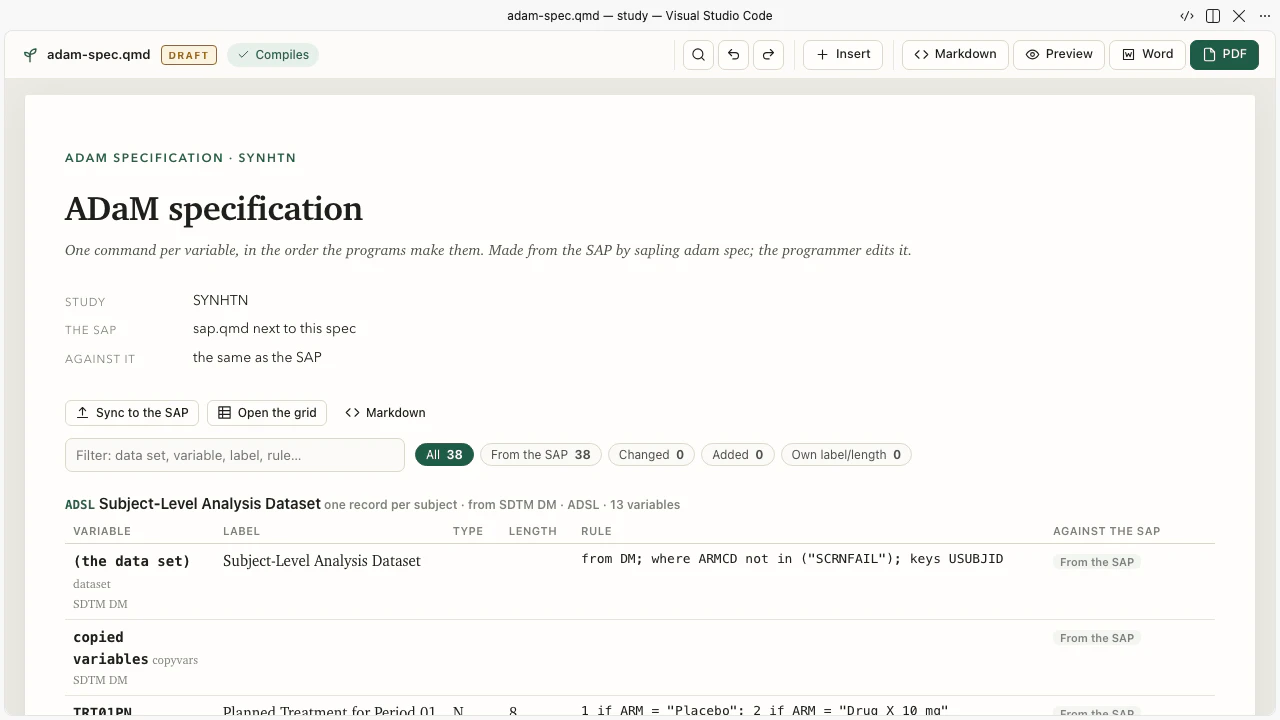
Section titled “11.3 The ADaM specification”adam-spec.qmd is the programmer’s file. It says how each variable is derived, one command per variable, in the order
the programs make them. Here are the population flags of ADSL:
### Analysis populations []{.cite source="protocol:4.1" words="In general, all patients will"}
::: {.flag variable="ADSL.ITTFL" condition="ARMCD is not missing" label="Intent-To-Treat Population Flag"}:::
::: {.flag variable="ADSL.SAFFL" condition='ITTFL = "Y" and TRTSDT is not missing' label="Safety Population Flag"}:::
::: {.flag variable="ADSL.EFFFL"    condition="SAFFL = \"Y\" and any QS(QSCAT = \"ALZHEIMER'S DISEASE ASSESSMENT SCALE\" and VISITNUM > 3) and any QS(QSCAT = \"CLINICIAN'S INTERVIEW-BASED IMPRESSION OF CHANGE (CIBIC+)\" and VISITNUM > 3)"    label="Efficacy Population Flag"}:::
::: {.derive variable="ADSL.VIS24DT" rule="date(SVSTDTC)" from="SV" where='VISIT = "WEEK 24"' work="true"}:::
::: {.flag variable="ADSL.COMP24FL" condition="VIS24DT is not missing" label="Completers of Week 24 Population Flag"}:::| Flag | Population | Rule |
|---|---|---|
ITTFL |
intent-to-treat | the patient has an arm: randomized |
SAFFL |
safety | randomized and has a first dose date |
EFFFL |
efficacy | in the safety population, with an ADAS-Cog record and a CIBIC+ record after visit 3 |
COMP24FL |
completers of week 24 | has a week 24 visit |
The heading cites the protocol sentence of section 4.1, as every block of the SAP does.
Your turn 11.1 The dose as a number
Open adam-spec.qmd in the editor and find the rule of ADSL.TRT01PN. Which values does it give, and where does the SAP use them?
Show the answer
::: {.derive variable="ADSL.TRT01PN" rule='0 if ARMCD = "Pbo"; 54 if ARMCD = "Xan_Lo"; 81 if ARMCD = "Xan_Hi"' label="Planned Treatment for Period 01 (N)" type="N" length="8"}:::Placebo is 0, the low dose 54, the high dose 81 (mg of xanomeline). The primary ANCOVA of chapter 7 uses the dose as a
number (TRTPN): its coefficient τ tests a linear dose response, the hypothesis H1 of the multiplicity block.
What you learned
- The SAP says what; the specifications say how; the programs are made from both and never edited by hand.
sapling buildmakes the three parts in order: the SAP, the specifications, the programs.- The population flags of ADSL carry the populations of the SAP into the data.
Next: 12 · The ADaM data in R →
Found an error or have a question? Write to datastep.studio@gmail.com· The plan is written in Sapling; every R program runs in DataStep Studio for R.
Data: the CDISC pilot study (cdiscpilot01). The protocol as CDISC USDM from the CDISC 360i project (MIT licence); the SDTM data from the PhUSE scripts repository (MIT licence). Public example data: no real patient.
R is a project of the R Foundation. SAS is a registered trademark of SAS Institute Inc. CDISC, SDTM, ADaM and USDM are trademarks of the Clinical Data Interchange Standards Consortium. Claude is a trademark of Anthropic. This book is not affiliated with or endorsed by any of them.
© 2026 DataStep Labs. All rights reserved.